
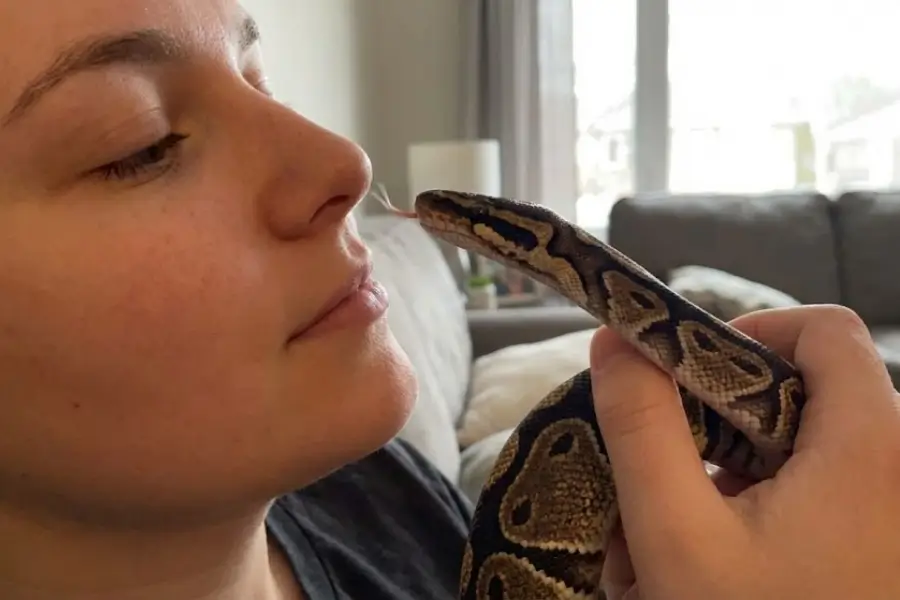
It’s a question that has divided reptile enthusiasts and scientists for years: does my snake know who I am? When a Ball Python calmly explores its owner’s arm or a Corn Snake eagerly awaits feeding time, it’s easy to project human emotions like affection and recognition onto them. After all, the bond we feel with our pets is very real. But to understand the true nature of the relationship between a human and a snake, we must step away from our mammalian perspective and delve into the fascinating, instinct-driven world of the reptilian brain.
The short answer is complex. While snakes do not possess the neurological structures to feel love or affection in the way a dog or cat does, evidence suggests they are capable of recognizing their owners through a process of association and familiarity. They can learn to distinguish between people, but their “bonding” is rooted in survival instincts rather than social connection.
The Reptilian Brain and Emotions

The primary reason snakes don’t form emotional bonds like mammals is biology. Mammalian brains have a well-developed limbic system, the area responsible for complex emotions like love, fear, and social bonding. This is why a dog will wag its tail when you come home, it feels a genuine emotional response to your presence.
Snakes, on the other hand, have a much simpler brain structure. Their behavior is largely governed by the “reptilian brain,” which is focused on basic survival needs like finding food, regulating body temperature, and avoiding predators. When a snake seems “happy” to see you, it’s more likely a conditioned response based on the expectation of food or warmth, not a feeling of affection.
How Snakes Perceive the World
To understand how a snake might “recognize” its owner, we must look at how they experience the world. Their primary sense is not sight or hearing, but scent.
– Scent and the Jacobson’s Organ: A snake’s most powerful tool for recognition is its forked tongue. When a snake flicks its tongue, it collects chemical particles and places them into the Jacobson’s organ. This helps the snake identify its owner by their unique scent profile.
– Vibrations: Snakes are incredibly sensitive to vibrations transmitted through the ground. They can likely learn the unique vibration pattern of their owner’s footsteps.
– Vision: While many snakes have relatively poor eyesight, they are sensitive to movement. They can learn to recognize your size, shape, and the way you move.
Recognition Through Association
When a snake “recognizes” you, it’s not a conscious thought. Instead, it’s a learned association. Through repeated positive interactions, the snake’s brain creates a link between your specific sensory cues and positive outcomes.
You are the source of:
– Food: This is the strongest motivator. If you are the only one feeding the snake, it will quickly learn to associate your presence with mealtime.
– Warmth: As ectotherms, snakes rely on external heat sources. They learn that being held by you is a comfortable and pleasant experience.
– Safety: A snake that is handled gently learns that you are not a predator. Your presence becomes associated with a lack of threat.
Signs of Trust and Comfort
While snakes may not show love, they do show signs that they trust you and feel secure in your presence. A snake that is comfortable with its owner will typically:
– Be Calm When Handled: It won’t try to constantly flee, strike, or musk.
– Explore Freely: It will move around inquisitively, tongue-flicking to investigate, rather than seeking a hiding spot.
– Show No Defensive Behaviors: It won’t hiss, flatten its body, or coil into a defensive “S” shape when you approach.
– Show Curiosity: Some snakes will readily come to the front of their enclosure when they see their owner.
Building a Positive Relationship
You can build a strong sense of trust with your snake through consistent, positive interactions.
– Gentle, Confident Handling: Support their body fully and avoid sudden, jerky movements.
– Respect Their Needs: Don’t handle your snake when it’s shedding or just after it has eaten, as these are times when they feel vulnerable.
– Routine: Snakes thrive on routine. Feeding, cleaning, and handling at predictable times can help them feel more secure.
Conclusion
In conclusion, while snakes may not be capable of the deep emotional bonds we share with mammals, the relationship between a snake and its owner is still significant. It is a relationship built on trust, respect, and mutual understanding. A snake that recognizes you as a safe, non-threatening presence is a testament to your patience and good husbandry.














0 Comments